

The days before Thanksgiving can be busy, but a seasonal lesson can still give children useful reading practice. A turkey mystery, a quick word-building routine, and a short gratitude message create several ways to use language without filling the day with unrelated worksheets.
These Thanksgiving literacy activities combine CVC reading, spelling, speaking, and writing. Choose the parts that fit your learners and spread them across the week. The phonics practice suits children working with taught short-vowel patterns; the speaking and writing can be adapted for a wider range of elementary English learners.
1. Start with a Thanksgiving CVC mystery
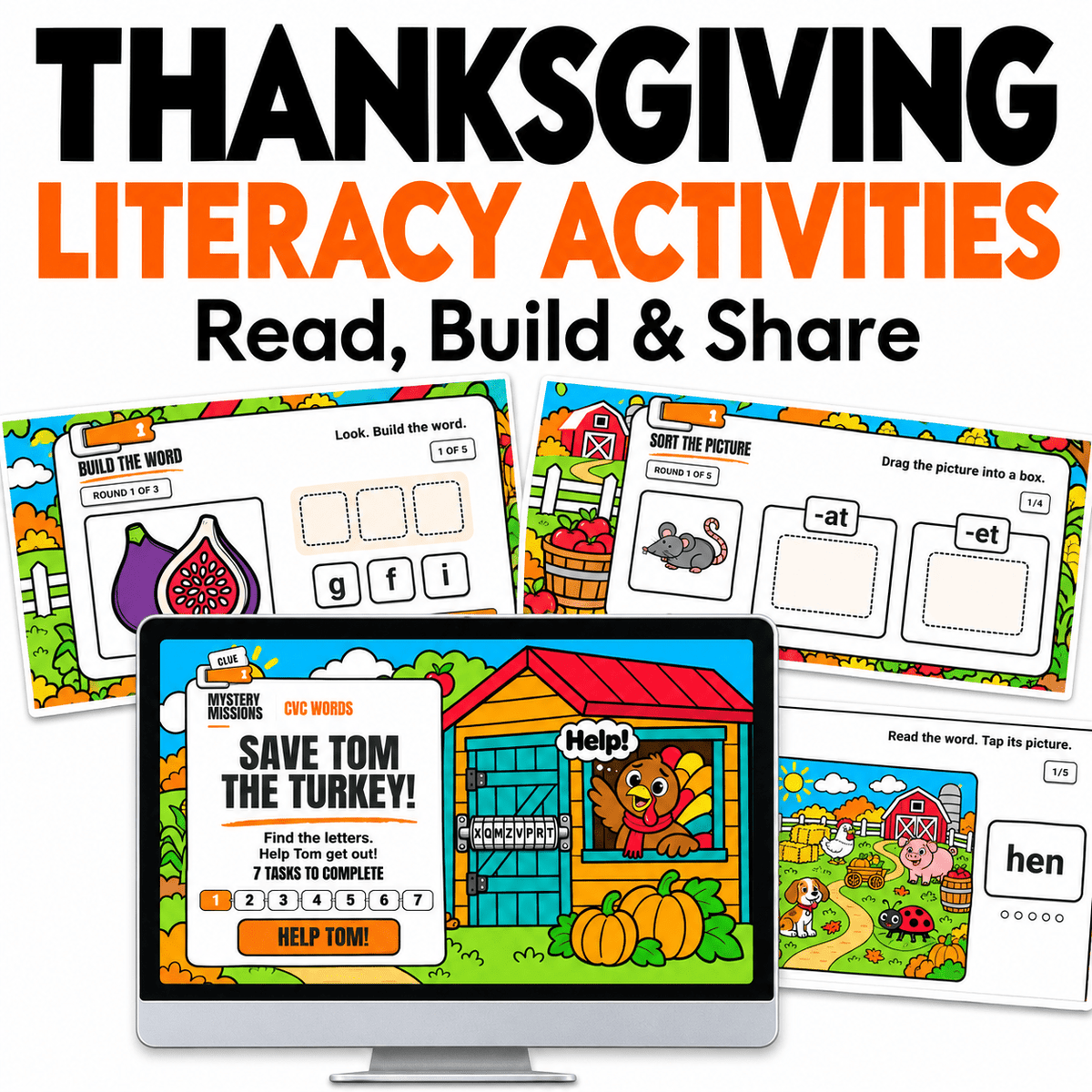
In Save Tom the Turkey!, Tom is stuck in the barn and needs help recovering lost code letters. Students complete seven picture-supported phonics activities across farm settings and use the collected letters in the final lock challenge.
The resource is designed for Kindergarten–Grade 1 and beginning ESL/ELL readers. It reviews all five short vowels through reading, word building, word-family work, and picture-supported choices. Preview the phonics demands before assigning independent play.

2. Build a word, change a sound, read again
Before the digital adventure, give each pair paper letter cards. Model a familiar CVC word, say its sounds, and build it from left to right. Ask students to blend the completed word before changing one letter.
For a teacher-created example, build cat, change it to hat, and then to hot. Ask which sound changed each time. These are suggested lesson examples, not a list of game answers. Keep the sequence within the spellings your class has learned.
A simple paper turkey can provide a seasonal display: write one correctly built word on each paper feather. The reading and spelling happen before decorating, so the craft supports the lesson’s purpose.
A teacher’s perspective: listen before offering a clue
When a child pauses, first find out what is difficult. Ask the learner to say the sounds or read the word aloud. An unfamiliar picture label needs vocabulary support; a mixed-up middle vowel needs attention to the sound and spelling. Those calls for help deserve different responses.
In partner play, alternate reader and checker roles. The checker explains a letter choice or blends the finished word rather than simply confirming a click.
3. Build Thanksgiving vocabulary with Picture Bingo
Use the Thanksgiving Picture Bingo Game for a listening and vocabulary center. The printable set includes 30 bingo boards and 24 illustrated calling cards. Preview a few words from the deck with the pictures before students start covering squares.
Call a word, pause, and ask partners to point to the matching picture and say the word. For a second round, have a student caller choose a picture and give a short clue using words the class already knows. If learners can find a picture with a clue but miss it when they hear the word alone, give that word another quick review.

4. Make gratitude speaking specific
Move from phonics to a separate oral-language activity with a clear purpose: thank someone for something they do. Model “Thank you for helping me” and invite students to name an action they appreciate at school.
Give partners time to rehearse before sharing. Learners can thank a classmate, a school helper, or a person they choose. Offer a fictional classroom example for anyone who would rather not share personal information.
Rehearse complete sentences with Thanksgiving cards
Before the thank-you exchange, use the Thanksgiving Finish the Sentence Game as a speaking warm-up. Its 80 open-ended cards give students practice completing sentences with nouns, verbs, and adjectives. Give pairs one starter and have each student offer a different ending. Ask them to read both completed sentences aloud and check whether each one makes sense.
For students who need more support, offer two possible words or read the starter together first. Then put the cards aside and return to the class model: “Thank you for ___.”

5. Turn a spoken thank-you into a short note
Have students say their message aloud, then write or dictate it. Beginners can use “Thank you for ___.” More confident writers can add a specific example: “Thank you for helping me find my book.” Read the note back together and check that the reader can understand the message.
Keep the tasks distinct: a gratitude note may contain spelling patterns beyond CVC words. Supply needed vocabulary or scribe the message so children can communicate an idea without pretending every seasonal word is decodable at their current level.
Extend gratitude writing with a Thanksgiving flap book
The Thanksgiving Flap Book gives students another way to share a gratitude message. Use the brainstorming page to gather ideas, then invite students to write under four flaps for people, places, experiences, and things. Model a sentence such as “I am thankful for the school library because I can borrow books.”
If you only have a few minutes, have each student choose one flap, say a sentence to a partner, and write or dictate it. Students can also use a class example or keep their flap book private.

Plan the week around a clear learning goal
| Activity | Main focus | Quick check |
|---|---|---|
| Letter-card word chain | Map sounds to letters | Read a word after one letter changes |
| Save Tom the Turkey! | Apply taught CVC patterns | Explain a vowel or word-building choice |
| Thanksgiving Picture Bingo | Connect spoken words to pictures | Point to the match and say the word |
| Sentence cards and partner thank-you | Rehearse a meaningful sentence | Name an action being appreciated |
| Written note or gratitude flap book | Communicate to a reader | Read back and clarify the message |
Set up the online adventure
Mystery Missions are online mystery/escape games that can be played individually, with partners or small groups, or together as a teacher-led class. Follow the resource’s activation instructions, generate a classroom code, and let students join with a nickname or team name. Students do not need email accounts.
Use an internet-connected desktop, laptop, Chromebook, or compatible tablet. The games are not designed for phones. Test Mystery Missions on your school device before purchasing. Preview your chosen mission and reserve a full lesson block, with extra time for joining and follow-up if needed.
Support and extend the lesson
Reduce the number of letter choices for children who need a clearer starting point. Preview unfamiliar picture vocabulary and read story directions aloud. For an extension, ask learners to create a new real-word chain and explain every sound change.
Finish with a fresh CVC word to read and another to spell from dictation. That brief independent check helps you plan the next phonics lesson after the Thanksgiving excitement.
Optional Amazon classroom tools
As an Amazon Associate I earn from qualifying purchases. The links below are affiliate links.
Learning Resources Hand Pointers
Use a pointer to track a displayed word or highlight a detail in a shared sentence. Invite the reader to explain the selected letter or word before passing the pointer to the next student.

View Learning Resources Hand Pointers on Amazon
Learning Resources Recordable Answer Buzzers
Add a turn-taking cue to a teacher-led review round. Give everyone thinking time, select a team, and have students explain their answer before using the buzzer. Keep the focus on a thoughtful response rather than speed.

View Learning Resources Recordable Answer Buzzers on Amazon
Both tools are optional. A finger for tracking and a spoken turn cue work with the same routines.
Frequently asked questions
Do I need to complete every activity in one lesson?
No. Use the word-building routine as a warm-up, schedule the mission separately, and save the gratitude note for a later speaking-to-writing lesson.
Can English learners participate?
Yes, with vocabulary previews, visual support, oral rehearsal, and phonics work matched to what they have been taught.
Where can I see the digital activities?
Explore Save Tom the Turkey! and view the activity previews.


