

Creative Ways to Use Grammar Task Cards in ESL Classrooms

Grammar task cards turn practice into purposeful language use. Instead of completing a long worksheet, students move, talk, make choices, and apply one grammar skill at a time. With a clear routine, the same set of cards can support whole-class teaching, small-group practice, independent review, and quick assessment.
Task cards are especially useful in ESL and EFL classrooms because they create short, manageable challenges. Learners can repeat a structure several times, receive feedback quickly, and build confidence before using the language in a longer conversation.
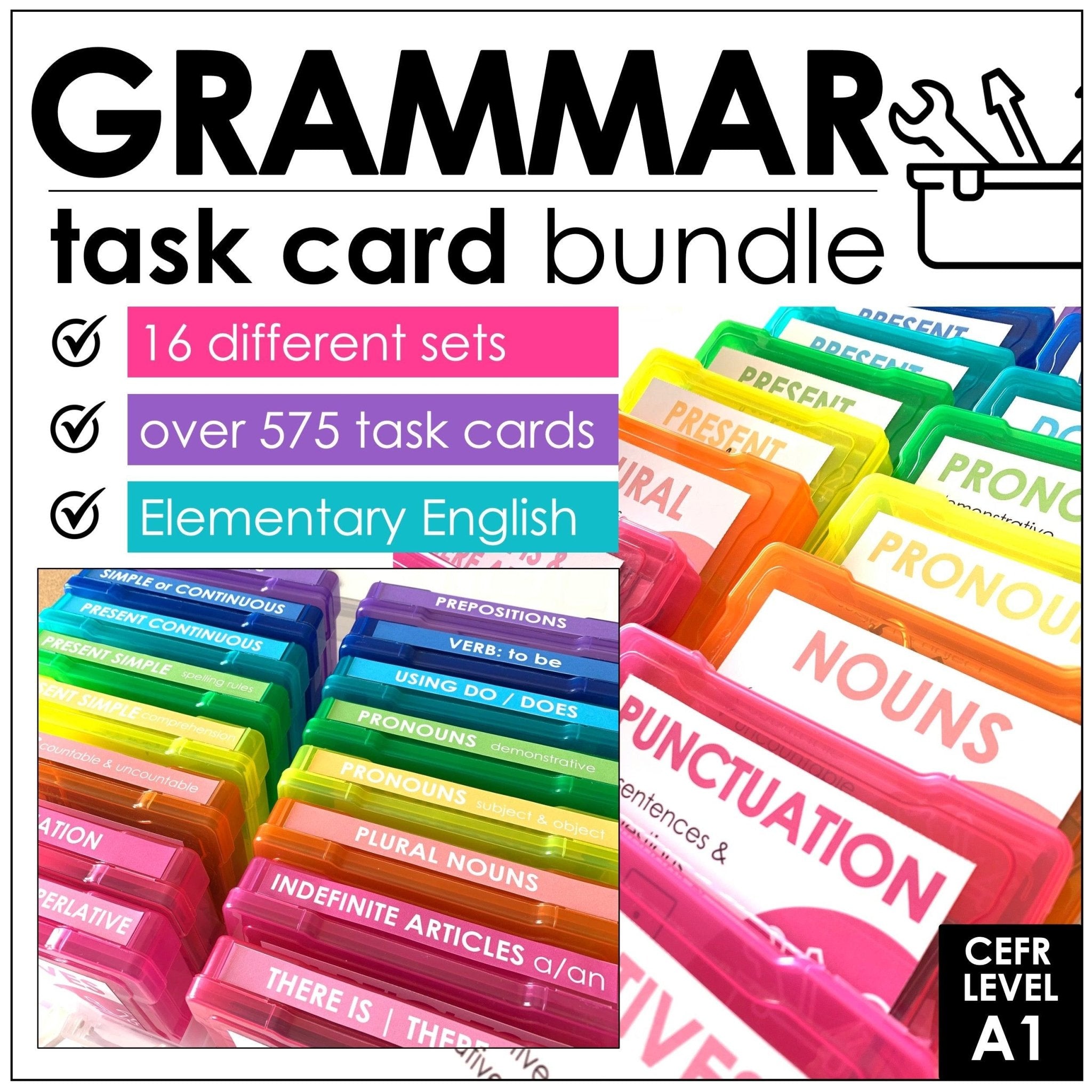
Explore the ESL Grammar Task Cards Bundle
Why grammar task cards work
A well-written task card gives students one clear prompt and one immediate reason to use English. That simplicity makes the activity easy to differentiate and easy to repeat throughout the year.
- Focused practice: each card highlights a specific grammar point instead of overwhelming learners with too many rules at once.
- More speaking time: pairs and teams can practise while the teacher circulates, listens, and gives targeted feedback.
- Flexible grouping: use the cards with the whole class, in stations, with partners, or for independent review.
- Built-in repetition: students meet the same structure in many different examples and contexts.
- Easy differentiation: provide sentence frames for beginners and extension questions for more advanced learners.
Before the lesson, choose one language objective. For example, students might practise identifying nouns, forming questions, using prepositions, or changing regular verbs into the past tense. A focused objective keeps the task cards purposeful rather than turning them into a race to finish.
1. Create grammar task card stations
Station rotations are one of the easiest ways to make grammar practice active. Set up a different card set or challenge at each table, then move groups around the room after a fixed amount of time.
How to organize the stations
- Choose three or four targets: combine familiar skills such as parts of speech, verb forms, sentence order, and prepositions.
- Give every station a model: show one completed example and list the language students should use when discussing an answer.
- Set a time limit: ten minutes per station is usually enough for a focused round.
- Assign group roles: reader, answerer, checker, and recorder can rotate so everyone participates.
- Review before moving: ask students to mark any card they found challenging and revisit it later.
Stations work well for mixed-level classes because you can place picture support, word banks, or sentence starters at one table while offering open-ended extension prompts at another.
2. Turn task cards into a dice or board game
Adding a simple game board gives students a reason to keep practising. Learners roll a die, move their piece, and draw a grammar card whenever they land on a designated space. To stay on the space—or move forward—they must answer accurately and explain their choice.
Use an editable board game template with any task cards you already own, or choose a ready-to-use grammar board game bundle.
Make the board game language-rich
- Ask the student to read the card aloud before answering.
- Require a complete sentence rather than a one-word response.
- Invite a teammate to explain why the answer is correct.
- Add a “challenge” space where students create their own example.
- Give a bonus point for clear pronunciation or a useful follow-up question.
Keep the competition friendly by rewarding accuracy, collaboration, and good explanations—not only the first team to reach the finish.
3. Run a timed task card race
A task card race adds energy to review without requiring complicated preparation. Divide the class into small teams, give each team the same stack of cards, and set a short time limit. Teams solve as many cards as they can, but every answer must be checked before it earns a point.
Keep the race focused on learning
- Choose ten to fifteen cards that match the grammar students have recently studied.
- Give teams a visible answer-recording sheet.
- Ask students to agree on an answer before writing it down.
- Check the cards as teams finish, or let students use an answer key for self-correction.
- Finish with a class review of the most common errors.
For a calmer version, remove the speed element and challenge students to earn a point for every answer they can explain. This works well for learners who need extra thinking time.
4. Use task cards for speaking and peer teaching
Grammar practice becomes more memorable when students have to explain, not just choose, an answer. Give each learner a card and ask them to read the prompt to a partner. The partner answers, then asks one follow-up question or creates a similar example.
Try these speaking extensions:
- Explain the rule: students say why the answer uses a particular tense, word form, or preposition.
- Correct and improve: partners fix the sentence and add one detail to make it more interesting.
- Find a match: students circulate until they find a classmate whose card uses the same grammar structure.
- Teach the class: pairs choose one challenging card and model the solution for everyone.
Provide sentence frames such as “I chose ___ because…,” “The verb changes to ___ because…,” and “Another example is…”. These supports make academic language accessible to developing speakers.
Differentiate task cards for every learner
The same resource can serve beginners, intermediate learners, and advanced students when the response requirement changes.
- Beginning learners: add pictures, a word bank, color coding, or a choice of two answers.
- Intermediate learners: ask students to answer and then write a complete sentence using the target structure.
- Advanced learners: require an explanation, a question for a partner, or a second example in a new context.
- Students who need extra support: use fewer cards, allow partner discussion, and revisit the same structures across several lessons.
Because each card is a small step, you can quickly regroup students and give additional practice without creating a completely different lesson.
A simple grammar task card lesson plan
- Warm up: review the target form with one example on the board.
- Model: demonstrate how to read a card, solve it, and explain the answer.
- Practise: choose stations, a board game, a race, or partner work.
- Coach: circulate, listen for patterns, and pause the class when a useful correction needs to be shared.
- Reflect: ask students to record one rule they remembered and one example they can now use.
Finish with a short exit ticket. Students can correct one sentence, write their own example, or explain a grammar choice in one or two lines. This gives you quick evidence of what needs to be reviewed next.
Make task cards easy to reuse
Print the cards on sturdy paper or laminate them before the first lesson. Store each grammar topic in a labeled envelope or box, and keep an answer key with the set. A consistent organization system makes it easy to grab a five-minute warm-up or plan a full station rotation.
Keeping task cards organized and easy to access makes them much easier to reuse. These color-coded photo keeper boxes are one practical storage option for classroom card sets. (This is an affiliate link.)
For more ready-to-use grammar games, card activities, and interactive review ideas, browse the ESL games collection on Hot Chocolate Teachables. You can also use the irregular past-tense games article for a focused follow-up lesson.
Ready to make grammar practice more active?
Choose one grammar objective, set up a small stack of task cards, and give students a clear way to talk about their answers. With stations, board games, races, and partner challenges, grammar review can become a routine students look forward to.
Find the ESL Grammar Task Cards Bundle and make your next lesson more interactive, focused, and easy to reuse.
Happy teaching!


